
12 Leave Policies
All absence from work must be authorized by the administrator. Absence from work without permission is cause for dismissal.
During leave events, any work authorized to be completed by an employee from an offsite location must be the same nature that the employee would perform while working within a library facility. If the employee is unable to perform the same form of work, then work associated with another existing library position may alternately be performed as long as the the employee requires no additional training to perform that work. (rev. 06.09.2020)
12.1 Personal Leave
- revised 12.10.2019; effective 01.01.2020
Personal leave with pay is available for library employees who are regularly scheduled to work 20+ hours per week. Personal leave is intended to provide opportunities for relaxation, vacations, and personal business. Employees are encouraged to use personal leave for these pursuits.
EARNING PERSONAL LEAVE
Employees begin to earn personal leave upon the completion of their first work day.Library employees accrue personal leave at a scheduled rate based on the number of regularly scheduled work hours per week and the number of years worked. The hours earned per month is calculated by applying the associated accrual rate to the employee’s hours worked per day, rounded to the nearest quarter hour. A day is defined as the number of hours regularly scheduled to work per week divided by five (5). Increases based on the number of years worked with take effect each January and awarded the following February.
Examples of Personal Leave Earning Rates:

USING PERSONAL LEAVE
- revised 03.26.2024; effective 04.01.2024
Personal leave is available for the employee’s use on the first day of the month after the leave is earned.
Personal leave can only be used after it has been earned and awarded. Personal leave is awarded after all of an employee’s work time for the month has been reported and approved by their immediate supervisor and/or the director.
All requests for personal leave must be approved in advance by an immediate supervisor using a designated leave request form. All requests for personal leave are approved at the discretion of the immediate supervisor, based on the operational needs and staffing requirements of the Library. Scheduled personal leave is not considered official until signed and dated by the supervisor.
Non-emergency leave requests must be submitted to a direct supervisor at least fourteen (14) calendar days before the leave date. Emergency leave requests must be communicated to a direct supervisor as soon as feasible. ‘Emergency’ is defined as an incident that could not reasonably be foreseen by the employee in order to prevent late notification of the need for leave benefits. An employee filing a late submission request may be required to provide documentable evidence of events occurring within the leave period.
While consideration of the employee’s activities outside of the workplace is critical to good and fair employee relations, in such instances maintaining proper staffing levels to meet patrons’ needs must take precedence over non-critical employee activities. For this reason, a supervisor may require an alternate working schedule in order to offset a portion or all of an employee’s personal leave request. Such schedule adjustments cannot require an employee to work more than 40 hours during a calendar week. Such adjustments will be based on the staffing needs of the library and not the personal preference of the employee.
Since no limitation is stated, personal leave continues to build indefinitely.
Personal leave may be taken in no less than one-quarter (1/4) hour increments.
Personal leave may be taken by employees for any reason, including sickness.
Holidays falling in a vacation period are not counted as personal leave.
SPECIAL CIRCUMSTANCES
When employees report personal leave usage during a week where their total hours for that week exceed their regularly scheduled number of work hours, the associated personal leave usage will be automatically offset up to the excess time worked, rounded to the nearest quarter (1/4) hour.
EMPLOYMENT TERMINATION
Employees who leave the library for any reason before twelve (12) months are completed may not take personal leave and may not be paid for any personal leave. All unused personal leave will be credited towards retirement by the Mississippi Public Employees Retirement System (PERS).
Employees who leave the library’s employ for any reason may not take personal leave after a termination notice or cause has been established.
Employees who leave the library's employ with two weeks’ (14 days’) notice following at least twelve (12) months of employment may opt to receive up to seven (7) days paid personal leave compensation. This payment may be incorporated into or paid after the employee’s regularly scheduled final paycheck. The payment must be processed before final personal leave balances are certified to the Mississippi Public Employees Retirement System (PERS).
All unused and uncompensated personal leave will be credited towards retirement by the Mississippi Public Employees Retirement System (PERS).
12.2 Sick Leave
- revised 09.14.2021; effective 09.15.2021
Sick leave with pay is available for library employees to be used for the illness or injury of the employee or a member of the employee's immediate family. Immediate family is defined by the Mississippi Code of 1972, Annotated, § 25‐3‐95 as: spouse, parent, step-parent, sibling, child, stepchild, grandchild, grandparent, son‐in‐law, daughter‐in‐law, mother‐in‐law, father‐in‐law, brother‐in‐law or sister‐in‐law. Child means a biological, adopted or foster child, or a child for whom the individual stands or stood in loco parentis.
WHEN NOT TO REPORT TO WORK
Employees who:
- Have tested positive for a contagious illness, or
- Have been exposed to an individual who has tested positive to a contagious illness, or
- Are experiencing (or have been exposed to someone experiencing) symptoms* of a contagious illness.
Should not report to work until:
- They have been supplied a doctor’s return to work release with an expired return to work date, or
- Have followed the current CDC guidelines for quarantine and testing, and
- Have been clear of all symptoms for at least 24 hours.
*Symptoms of contagious illnesses include but are not limited to chills, cough, shortness of breath or difficulty breathing, fatigue, muscle or body aches, headache, new loss of taste or smell, sore throat, congestion or running nose, nausea or vomiting, and diarrhea.
Employee illnesses resulting in more than three days’ loss of work may require a doctor’s return to work release.
Employees who experience long-term symptoms of a contagious illness will be analyzed for FMLA (Family and Medical Leave Act) benefit eligibility when an associated doctor’s visit, test confirmation, or completed federal FMLA Form WH-380-E is supplied by the employee.
Guidelines for long-term symptoms are only in effect when symptoms occur within the time frame presented on Form WH-380-E.
Once the Library Director has confirmed that proper documentation has been supplied, an employee should not report to work for at least 24 hours if experiencing a new manifestation of symptoms or worsening of symptoms. A new manifestation is defined as the onset of symptoms after the employee has been symptom free for at least fourteen calendar days.
EARNING SICK LEAVE
Employees regularly scheduled to work 20+ hours per week shall accumulate sick leave each calendar month at the same rate as established in the Mississippi State Employee Handbook. A day is defined as the number of hours regularly scheduled to work per week divided by five (5). Employees begin to earn and accumulate sick leave on the first working day of each month the employee works or receives paid leave.
Examples of Sick Leave Earning Rates:
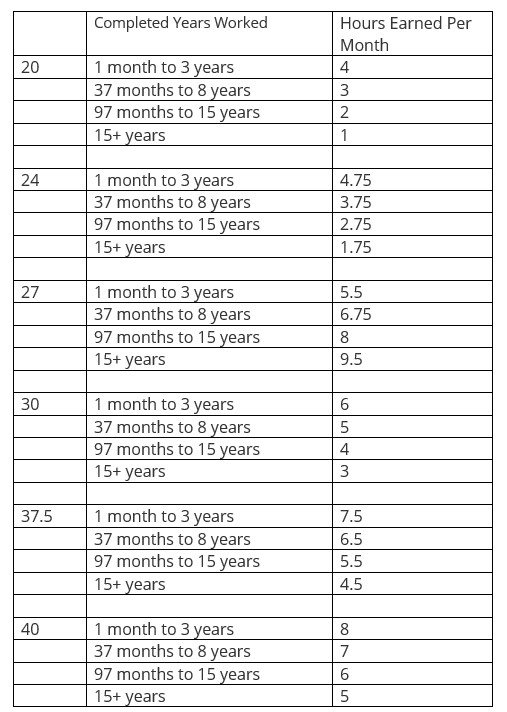
Sick leave is awarded after all of an employee’s work time for the month has been reported and approved by their immediate supervisor and/or the director. The leave is available for the employee’s use the first day of the month after the leave is earned.
There is no maximum limit to sick leave accumulation. All unused sick leave will be counted as creditable service for the purposes of the retirement system.
USE OF SICK LEAVE
Sick leave must be approved by the employee’s supervisor. Non-emergency sick leave requests must be made using a designated leave request form at least 7 days in advance of planned use. For emergency sick leave use, employees must notify a direct supervisor as soon as feasibly possible.
The Library reserves the right to request a doctor’s certification of illness for all sick leave usage incidents.
SPECIAL CIRCUMSTANCES
When employees report sick leave usage during a week where their total hours for that week exceed their regularly scheduled number of work hours, the associated sick leave usage will be automatically offset up to the excess time worked, rounded to the nearest quarter (1/4) hour.
Sick leave may be granted to employees who become ill while on vacation (preplanned use of personal leave) provided immediate notification is given to the Library and satisfactory medical proof is submitted. In such cases, the balance of the vacation will be reinstated. When a recognized holiday occurs during a paid sick leave period, the holiday will not be charged to sick leave.
During periods of FMLA coverage, employees will receive a sick leave allocation prorated for the number of days physically worked during a calendar month. A day is defined as the number of hours regularly scheduled to work per week divided by five (5).
EMPLOYMENT TERMINATION
Employees who leave the library’s employ for any reason may not take sick leave after a termination notice or cause has been established. No reimbursement will be given for unused sick leave to any employee leaving the library for any reason. All available unused sick leave will be credited to the Mississippi Public Employees Retirement System (PERS). A day is defined as the number of hours regularly scheduled to work per week divided by five (5).
LEGAL
Employees who fail to follow the guidelines within this policy are subject to disciplinary actions.
No portion of this Sick Leave Policy shall supersede legally mandated coverage, restrictions, or guidelines.
12.3 Unpaid Leave for Part-Time Employees
- effective 09.16.2020
Unpaid leave is available for library employees who are regularly scheduled to work less than 20 hours per week. Unpaid leave is intended to provide opportunities for relaxation, vacations, personal business, illness, and family emergencies.
With the adoption of this policy, part-time employees must have available leave benefits to provide for any variation or absence from their regular work schedule. See also, ‘Leave Without Pay’ policy.
EARNING UNPAID LEAVE
“Scheduled Hours per Week” is based on the number of hours listed on the employee’s Staff Notification of Payroll Status form.
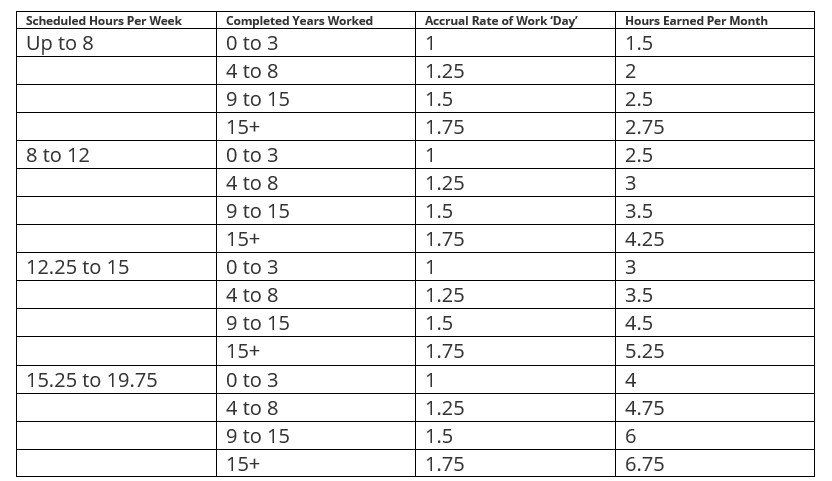
Part-time employees begin to earn unpaid leave upon the completion of their first work day. Unpaid leave is accrued at a scheduled rate based on the number of regularly scheduled work hours per week and the number of years worked. The hours earned per month is calculated by applying the associated accrual rate to the employee’s hours worked per day, rounded to the nearest quarter hour. A day is defined as the number of hours regularly scheduled to work per week divided by five (5). Increases based on the number of years worked with take effect each January and awarded the following February.
Examples of Unpaid Leave Earning Rates:
USING UNPAID LEAVE
Unpaid leave may be used after the completion of six (6) month of employment.
Unpaid leave can only be used after it has been earned and awarded. Unpaid leave is awarded after all of an employee’s work time for the month has been reported and approved by their immediate supervisor and/or the director.
All requests for unpaid leave must be approved in advance by an immediate supervisor using a designated leave request form. All requests for unpaid leave are approved at the discretion of the immediate supervisor, based on the operational needs and staffing requirements of the Library. Scheduled unpaid leave is not considered official until signed and dated by the supervisor.
Non-emergency leave requests must be submitted to a direct supervisor at least fourteen (14) calendar days before the leave date. Emergency leave requests must be communicated to a direct supervisor as soon as feasible. ‘Emergency’ is defined as an incident that could not reasonably be foreseen by the employee in order to prevent late notification of the need for leave benefits. An employee filing a late submission request may be required to provide documented evidence of events occurring within the leave period.
While consideration of the employee’s activities outside of the workplace is critical to good and fair employee relations, in such instances maintaining proper staffing levels to meet patrons’ needs must take precedence over non-critical employee activities. For this reason, a supervisor may require an alternate working schedule in order to offset a portion or all of an employee’s Unpaid leave request. Such schedule adjustments cannot require an employee to work more than 40 hours during a calendar week. Such adjustments will be based on the staffing needs of the library and not the personal preference of the employee.
Since no limitation is stated, Unpaid leave continues to build indefinitely.
Unpaid leave may be taken in no less than one-quarter (1/4) hour increments.
Holidays falling in a vacation period are not counted as Unpaid leave.
SPECIAL CIRCUMSTANCE
When employees report Unpaid leave usage during a week where their total hours for that week exceed their regularly scheduled number of work hours, the associated Unpaid leave usage will be automatically offset up to the excess time worked, rounded to the nearest quarter (1/4) hour.
12.4 Workers’ Compensation
All Library employees are covered by the Mississippi Workers' Compensation Law, Mississippi Code of 1972, Annotated § 71‐3‐1 et seq. which provides certain benefits in the event an employee suffers a work‐related injury or illness. In case of a work‐related fatality, the law guarantees payment of benefits to the spouse and dependents of the deceased.
Workers’ Compensation benefits are provided at no cost to the employee or dependents. For injury/illness, benefits may include payment of all reasonable and necessary medical expenses as well as partial compensation for wages lost due to the injury or illness. In certain cases, vocational rehabilitation may also be available.
Wage‐loss benefits for injury /illness are not paid for the first five (5) days of disability unless the disability extends fourteen (14) or more days. These benefits are payable at the rate of two‐thirds of the employee's average weekly wage. These benefits may also be subject to a weekly maximum set by law.
Workers’ Compensation claims are time‐sensitive. Employees must report claims within thirty (30) days after the occurrence, subject to statutory exceptions as outlined in the Mississippi Code of 1972, Annotated § 71‐3‐35. Any injury/illness that happens on the job should be reported immediately to the employee’s immediate supervisor to ensure appropriate medical treatment is provided and any wage loss benefits due the employee are paid without unnecessary delay.
12.5 Military Leave
The Uniformed Services Employment and Re‐employment Act of 1994 (USERRA, 38 U.S.C. Sec. 4301‐4335), grants re‐employment rights, within certain time limits, to soldiers who leave employment to perform military duty and who satisfactorily perform that duty. The right to re‐employment is not contingent on whether the orders were voluntary or involuntary. Re‐employment rights will be granted to employees who:
- provide the Library with advance written or verbal notice of the military service;
- do not have more than five (5) years of cumulative service in the uniformed services while employed by the Library;
- return to work or apply for reemployment in a timely manner after conclusion of service; and
- have not been separated from service with a disqualifying discharge or under other than honorable conditions.
Pursuant to Mississippi Code of 1972, Annotated § 33‐1‐21, employees are entitled to fifteen (15) days of paid leave when ordered to military duty, whether the orders were voluntary or involuntary. An employee requesting leave, pursuant to voluntary or involuntary orders, beyond the fifteen (15) days allowed by law is entitled to a leave‐of absence which can be charged against his/her accrued personal or compensatory leave.
If the employee does not have sufficient leave to cover the absence, the leave may be without pay. The employee is entitled to leave‐of‐absence from his/her respective duties without loss of time, annual leave or efficiency (performance) rating until relieved from duty.
For updates and additional details, see The Uniformed Services Employment and Reemployment Rights Act (USERRA) on U.S. Dept. of Labor’s website at https://www.dol.gov/agencies/vets/programs/userra/USERRA-Pocket-Guide.
12.6 Family and Medical Leave Act (FMLA)
- revised 12.10.2019; effective 12.10.2019
Employees who have worked for the Library for at least one (1) year and for one thousand two hundred and fifty (1,250) hours over the previous twelve (12) months are covered by the Family and Medical Leave Act (FMLA).
In compliance with FMLA, eligible Library employees are entitled to up to twelve (12) weeks of unpaid, job‐protected‐leave for the following reasons:
A. incapacity due to pregnancy, prenatal medical care or child birth;
B. to care for the employee's child after birth, or placement for adoption or foster care;
C. to care for the employee's spouse, son or daughter, or parent, who has a serious health condition; or
D. serious health condition that makes the employee unable to perform the employee's job.
A "serious health condition" is an illness, injury, impairment, or physical or mental condition that involves either an overnight stay in a medical care facility, or continuing treatment by a heath care provider for a condition that either prevents the employee from performing the functions of the employee's job, or prevents the qualified family member from participating in school or other daily activities.
According to FMLA guidelines, "Continuing treatment" is a period of incapacity of more than three (3) consecutive calendar days combined with at least two (2) visits to a health care provider. The two (2) visits to a health care provider must occur within thirty (30) days of the beginning of the period of incapacity and the first visit to the health care provider must take place within seven (7) days of the first day of incapacity.
A serious health condition includes more than three (3) consecutive full calendar days of incapacity plus a regimen of continuing treatment and the first visit to a health care provider must take place within seven (7) days of the first day of incapacity.
Incapacity may also be due to pregnancy or a chronic condition requiring periodic visits for treatment by a health care provider. A chronic condition requires at least two (2) visits to a health care provider per year.
During all FMLA leave, the employee's group health coverage will be maintained. Upon return from FMLA leave, the employee will return to the original or equivalent position with equivalent pay, benefits and other employment terms. Use of FMLA will not result in the loss of any employment benefit that accrued prior to the start of an employee's leave. Time spent performing assigned "light duty" work does not count against an employee's FMLA leave entitlement.
Employees must provide thirty (30) days advance notice of the need to take FMLA leave when the need is foreseeable. When thirty (30) days notice is not possible, the employee must provide notice as soon as practicable. The notice must be consistent with the usual and customary Library procedures for reporting an absence unless there are unusual circumstances.
Employees are required to provide sufficient information for an FMLA eligibility determination to be made. This information will also be used to determine the anticipated timing and duration of the leave.
U.S. Department of Labor (USDL) certification forms:
A. Serious health condition – USDL Form WH‐380‐E
B. Care for a covered family member – USDL Form WH‐380‐F;
C. Qualifying exigency for military family leave – USDL Form WH‐384;
D. Serious injury/illness of covered service member for military family leave – USDL Form‐385.
If information provided by the employee or the healthcare provider on the certification form is incomplete or insufficient, the employee will be notified, in writing, as to what information is lacking and given seven (7) calendar days to cure the deficiency. Employees may be required to provide a new medical certification each leave year for medical conditions that last longer than one year. Recertification may also be required every six (6) months for an ongoing condition resulting in recurring absences.
Eligible employees requesting leave will be informed as to whether said condition/exigency qualifies for FMLA leave. A FMLA‐qualifying employee:
- may use FMLA leave intermittently or on a reduced leave schedule when medically necessary or for qualifying exigencies.
- using FMLA leave intermittently must make reasonable efforts to schedule leave for planned medical treatment so as not to unduly disrupt Library operations.
- must also inform his/her supervisor if leave being requested is for a condition/situation for which FMLA leave was previously taken or certified.
The Library applies FMLA leave concurrent to accrued paid leave.‘Concurrent’ means the employee’s accrued leave is applied and paid in association with FMLA covered events.
During periods of FMLA coverage, employees’ sick and personal leave allocations are prorated for time that the employee physically works and/or utilizes accrued leave.
No Library employee may interfere with, restrain, or deny the exercise of any right provided under the Family and Medical Leave Act. No Library employee may discharge or discriminate against any person for opposing any practice made unlawful by the FMLA or for involvement in any proceeding under or relating to the FMLA.
Military Entitlement. An eligible employee is entitled to up to 12 weeks of FMLA leave because of any qualifying exigency arising out of the fact that the spouse, son, daughter, or parent of the employee is a member of any Armed Forces and/or a reserve component of the Armed Forces on covered active duty. Qualifying exigencies may include attending certain military events, arranging for alternative childcare, addressing certain financial and legal arrangements, attending certain counseling sessions, and attending post‐deployment reintegration briefings.
An eligible employee who is the spouse, son, daughter, parent, or next of kin of a covered service member who is recovering from a serious illness or injury sustained in the line of duty any time during the five years preceding the treatment is entitled to up to 26 weeks of leave in a single 12 month period to care for the service member. The twenty‐six (26) week entitlement applies to additional family members (i.e., next of kin) not previously covered for qualifying reasons. This entitlement is not in addition to the twelve (12) week FMLA entitlement for qualifying exigencies.
For updates and more detail see U.S. Dept. of Labor. Family and Medical Leave Act ‐ Overview at https://www.dol.gov/agencies/whd/fmla. Forms are available online at https://www.dol.gov/agencies/whd/fmla/forms.
12.7 FMLA Qualified Event Leave for FMLA Ineligible employees (FQE leave)
- effective 09.16.2020
FMLA Qualified Event Leave for FMLA Ineligible Employees (FQE Leave) is available to all employees who:
- are not eligible for Family and Medical Leave Act (FMLA) coverage
- have not utilized FMLA or FQE coverage within the last 365 calendar days prior to the qualifying event and
- have been employed by LLF for 182 calendar days prior to the qualifying event.
FQE Leave coverage is activated on the first day in which the employee is unable to report to work due to a qualifying event and the employee has exhausted all other sick leave benefits.
Qualifying events are defined by FMLA guidelines. FMLA forms may be utilized at the Library’s discretion.
Once activated, the FQE leave period begins with the date of the qualifying event.
FQE Leave coverage does not extend past the physician’s return to work date, regardless of the total number of days of FQE leave available for use.
Compensation is not awarded for FQE leave coverage.
Years of Employment Coverage
183-365 days 7 consecutive calendar days
366-730 days 14 consecutive calendar days
731+ days 21 consecutive calendar days
12.8 Sabbatical Leave
In accordance with the §39‐3‐20 of the Mississippi Code of 1972, Annotated, professional Library staff members are eligible for sabbatical leave for professional improvement, for up to one (1) year immediately following any six (6) or more consecutive years of active service. Absence on sick leave does not affect staff eligibility. Sabbatical leave for professional staff members must have the approval of the Administrative Library Board of Trustees.
Applications for sabbatical leave may be made to the administrative board of trustees, with the approval of the Director. Any person who is granted a sabbatical leave and who fails to comply with the provisions of such leave may have his/her leave terminated by the administrative board of trustees. Employees on sabbatical leave are not denied any regular increment of increase in salary because of absence on sabbatical leave.
A person on sabbatical leave shall enjoy all the rights and privileges pertaining to his/her employment, such as health insurance and credit for active service for the purpose of retirement and contributions to the retirement fund consistent with regulations of the Mississippi Public Employees Retirement System. Leave will not be granted unless there is a contract providing for continued service in the Library, after expiration of the leave.
Each person granted sabbatical leave may receive and be paid compensation up to the rate of fifty percent (50%) of such person's annual salary. Compensation payable to persons on sabbatical leave will be paid at the same time and in the same manner salaries of the other employees of the Library are paid.
12.9 Funeral Leave
Leave with pay may be granted at the discretion of the administrator for one-half (1/2) to three (3) days upon the death of a member of an employee's immediate family related in the first (1st) or second (2nd) degree.
Each case must be individually approved by the administrator. If funeral leave is not granted, annual leave may be used if the library's services will not be adversely affected.
12.10 Jury Duty
Leave with pay is granted to full-time employees for jury duty. The administrator must be informed immediately when a summons is received. If the employee is excused from jury duty, he must report to work.
12.11 Leave without Pay
- revised 12.10.2019; effective 12.10.2019
The Library does not provide leave without pay unless such leave is protected by legally protected benefits (ex. Family and Medical Leave Act> or as outlined within the employee guidelines.
12.12 Disaster Leave (replaced 'Inclement Weather')
- adopted 06.09.2020; effective 06.09.2020
DEFINITIONS
- Disaster – any weather, environmental, or societal event impacting a significant portion of the Library’s public service area that restricts the Library’s ability (or a Library employee’s ability) to provide library operations from within the Library’s facilities
- Disaster pay rate – equal to an employee’s hourly pay rate, provided each pay week for up to 50% of an employee’s regularly scheduled weekly work hours; applied after all other available and applicable leave options have been utilized
- Disaster leave – the total time for which disaster coverage is provided and employer provided payroll benefits protected
- Salaried employees – employees regularly working 20+ hours a week and who are eligible for payroll benefits
- Short-term disaster – a disaster leave event lasting up to 3 consecutive business days
- Long-term disaster – a disaster leave event lasting more than 3 consecutive business days
OVERVIEW
The Library Director will notify Library staff (1) when any event activates the Disaster Leave Policy and (2) when the associated disaster event’s coverage has ended.
During any period of a disaster, the Director may choose to temporarily reassign employees to work at another Library branch or area of service. In such situations, employees are not eligible to receive travel reimbursement associated with the reassignment.
SHORT-TERM DISASTER
-revised 03.26.2024; effective 04.01.2024
In the event of a short-term disaster, all salaried employees will be eligible for Administrative Leave at the discretion of the Library Director. All eligible employees will be paid at their regular rate of pay for their regularly scheduled work hours during Administrative Leave. All employees who work less than 20 hours per week will be allowed to make up lost work hours at the discretion of the Library Director.
LONG-TERM DISASTER
System-wide Long-Term Disaster Events
Disaster pay is available to salaried employees. Disaster pay for long-term disasters begins on day 4 of a disaster event with days 1-3 covered under the provisions of short-term disaster coverage.
Salaried employees may be allowed to or required to work remotely during the disaster. Salaried employees who have demonstrated an ability to work remotely are not allowed to refuse work assignments on the basis of the assigned workload exceeding 50% of their regularly scheduled number of weekly work hours.
Employee Specific Long-Term Disaster Events
Long-term disaster pay is not available. Salaried employees may be allowed to work remotely.
Long-term disaster leave is available for:
- up to five (5) consecutive business days for a single disaster event
- up to two (2) disaster events per calendar year.
GUIDELINES
Upon return to work, non-salaried employees may be allowed to work additional hours to make up for lost wages.
Employees are responsible for tracking their work time regardless of where work is performed. Employees must keep a daily log of work activities.1 Work logs must be provided on demand and must also accompany submitted time-sheets. Work content and quality should meet any minimum standards set by the Director or employee’s immediate supervisor. Employees must communicate their time-sheets and work logs to the Director before payroll funds can be distributed.
The Library may, but is not required to, supply employees with library equipment and office supplies to support off-site work requirements. All Library resources taken off-site must be checked out to the employee through the business office.
When off-site work is performed during a disaster event, the work may be performed any time within a Mon-Sun calendar week, unless the employee is provided specific instructions for providing services within a specific time-frame. (Example, employee is assigned to provide phone support 10:00-11:00).
AUTHORITY
All compensation guidelines outlined within this policy may be altered at any time by decision of the Lincoln Lawrence Franklin Regional Library Board of Trustees or other higher authorities.
12.13 Leave Donations
- adopted 12.10.2019; effective 12.10.2019
Any employee may donate any portion of his/her accumulated personal leave to another employee’s sick leave balance if the recipient employee is incurring a loss of work due to a FMLA covered event.
The donated leave will be placed in a ‘donated sick’ leave category. Donated sick leave will be fully depleted before any earned sick leave will be utilized.
Ineligible Donations:
Employees who are covered under an active FMLA event are ineligible as donors.
Donations may not be made to individuals whose FMLA coverage has expired or been fully utilized.
Retroactive donations are not allowed.
Limits on Solicitation
Under no circumstances may an employee solicit leave donations for themselves or from employees under their direct supervision. Such activity will be subject to disciplinary action.
Donation Process
In order to donate leave, the providing employee must submit to the Library Director an original and fully completed Employee Leave Donation Form. The Director will notify the donor if invalid forms are received.
The Director will notify the donor in writing or via email when a completed donation form has been received.
Donation requests cannot be revoked by the donor once a completed donation form has been filed with the Director.
The Director will notify the donor in writing or via email once the donation has been approved (or not).
The effective date of an approved donation is set to the date that the Director receives a completed donation form.
Donor Privacy
The Library will under no circumstances disclose the name of the donor to the recipient.
Recipient Acceptance
The recipient retains the right to reject all leave donations. In the process of approving leave donations, the Director will contact the designated recipient in writing or e-mail to inform the employee about the donation details. The designated recipient must accept or reject the donation in writing or via e-mail before the donation can be approved.
When encountering situations where illness or injury prevents the donor recipient from providing written feedback to the Director, verbal communication may be substituted for written documentation. Where verbal communication is not feasible, the Library will assume that the donation is acceptable to the recipient.
Potential Conflicts with Payroll Processes
The application of leave donations may conflict with payroll processing activities. If this occurs, applicable leave payments will be processed during the following regularly schedule payroll process. Payroll processing activities will not be held or retracted to accommodate payment association with a leave donation.
Unused Donated Leave at Retirement/Termination
The Mississippi Public Entity Retirement System (PERS) Regulation 51 advises that:
“Leave donated or transferred from one employee to another employee may not be certified to PERS as unused leave of the recipient employee. The accumulation of leave is personal to the individual employee. Only qualifying leave which has actually been accumulated by and which remains unused by the individual employee at termination of employment may be certified to PERS for service credit.”